

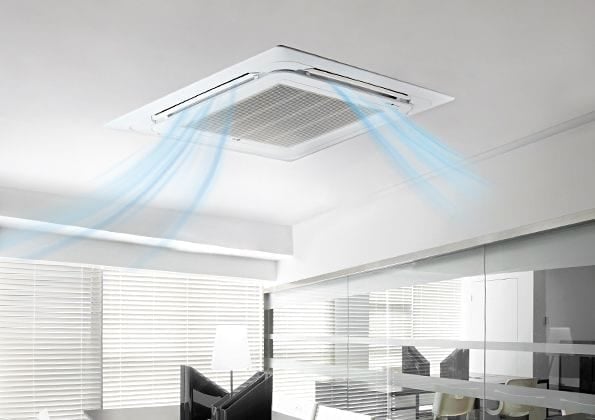
If you’re looking to heat and cool your home efficiently and have heard of fan coil units, this guide is for you. We’ll explain what they are, how they work, the different types available, and when they’re a better choice than traditional air conditioning—straight to the point and with the information you need to make a decision.
What is a fan coil unit?
A fan coil unit is a device that heats or cools the air in a room using water—hot water to heat, cold water to cool. A fan draws air from the room through a coil (heat exchanger) through which this water circulates, and returns the air at the desired temperature. Unlike split-system air conditioners (which use refrigerant gas in each unit), fan coil units operate using water supplied from a central source.
How It Works (the Water + Heat Pump Principle)
The fan coil unit is the part located inside the home; the water that feeds it typically comes from a heat pump (or a chiller). It is this combination that makes it so efficient:
- The heat pump produces hot water (in winter) or cold water (in summer) with very low electricity consumption.
- This water circulates through piping to the fan coil units in the various rooms.
- In each room, the fan coil unit exchanges heat with the air and regulates the temperature.
Result: a single system heats the home in winter, cools it in summer, and can even provide domestic hot water—all with the efficiency of a heat pump.
Types of fan coil units
- Wall-mounted — installed on the wall, similar to an air conditioner; discreet and easy to install.
- Floor-standing — placed near the floor, ideal for replacing radiators.
- Cassette (ceiling) — recessed into a drop ceiling, distributes air in multiple directions; widely used in retail spaces and offices.
- Ducted — concealed in a drop ceiling, connects to vents in various rooms for centralized, invisible climate control.
Fan Coil Unit vs. Air Conditioner: Which One Should You Choose?
| Criterion | Fan Coil Unit (water) | Split air conditioner (gas) |
|---|---|---|
| Source | Heat pump/chiller water | Refrigerant gas per unit |
| Ideal for | Centralized heating + cooling + DHW | Cooling 1 or a few rooms |
| Comfort | Very even and quiet | Good, more localized |
| Scalability | Multiple units on the same water circuit | Each zone requires its own unit |
| Best scenario | House/building with a heat pump | Simple renovation of a single room |
Advantages of fan coil units
- Efficiency: They take advantage of the heat pump’s efficiency—much more economical than electric or gas heating elements.
- 2-in-1 (or 3-in-1): heating and cooling in the same unit, and the system can also provide hot water.
- Comfort and quiet operation: uniform temperature and discreet operation.
- Flexibility: various models (wall-mounted, console, cassette, ducted) for every type of space.
When is it worth it?
Fan coil units make the most sense when you already have (or plan to install) a heat pump and want to heat or cool multiple rooms centrally and efficiently—in single-family homes, renovations, and commercial buildings. To quickly cool or heat just one room, a split-system air conditioner may be sufficient. When in doubt, proper sizing makes all the difference—and that’s where a certified team comes in.
LEFE takes care of everything
At LEFE, we specialize in efficient climate control and supply fan coil units for all applications (wall-mounted, console, cassette, and duct-mounted), along with heat pumps. We handle the design, sizing, and turnkey installation—with a certified team (DGEG and for fluorinated gases)—and, when applicable, we handle the application for grants from the Environmental Fund. Request a free quote and discover the best solution for your home or business.