
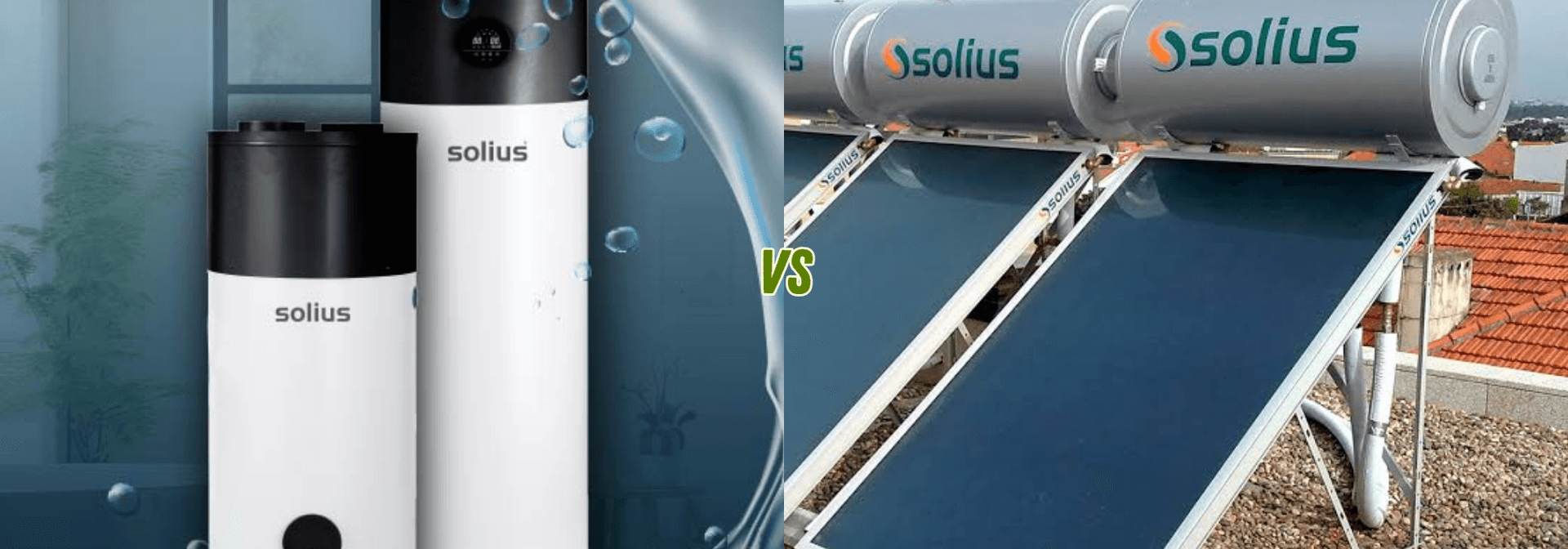
When the time comes to replace a water heater or equip a new home, the question almost always arises: solar thermal or a heat pump for domestic hot water (DHW)? Both solutions are efficient, and both lower your bill, but they aren’t exactly suited for the same situation. In this article, we compare solar thermal and heat pumps using real data from two LEFE projects—a thermosiphon solar thermal storage tank and a DHW heat pump—so you can make an informed decision based on facts, not just on “we think.”
In summary:
- ☀️ Solar thermal: zero electricity consumption for circulation (thermosiphon), but it depends on solar radiation and requires a south-facing roof.
- 🔥 DHW heat pump: consumes electricity, but up to 3 to 4 times less than a conventional electric water heater, with a COP of up to 3.9.
- 💶 Real-world example: HENQ 300L heat pump installed for €1,931.20 (including VAT); Solius 200L solar thermal kit costs around €1,450 (excluding VAT) for the equipment alone.
- 🏠 A 200–300-liter storage tank, regardless of the technology used, covers the typical consumption of a family of 3 to 4 people.
- 🧾 Note on VAT: The reduced 6% rate for solar equipment expired on June 30, 2025—today, the standard 23% rate applies, unless otherwise specified by law.
How thermosiphon solar thermal systems work
A solar thermal system harnesses solar radiation to directly heat domestic water—for showers, cooking, and laundry—which, after heating and cooling, typically accounts for the largest share of a home’s energy consumption. In the kits we install most frequently, the thermosiphon model doesn’t even require a circulation pump:
- The solar collector on the roof heats the water flowing through it.
- This heated water becomes lighter and rises naturally to the storage tank, which is always positioned above the collector—just like smoke rising on its own up a chimney.
- The cold water, which is heavier, flows down to the collector, and the cycle repeats as long as the sun is shining.
- A backup electric heating element (with a thermostat) kicks in only on days with less sunlight, to ensure hot water even when the sun isn’t shining.
The result is a simple, reliable, and virtually maintenance-free system, because it has no circulation pump or control electronics to monitor—just the essentials: a collector, a vitrified storage tank, and safety valves.
How a heat pump for domestic hot water works
A DHW heat pump does not depend on the sun: it extracts thermal energy from the ambient air and transfers it to the water in the tank, even at night or on cloudy days. A compressor raises the temperature of a refrigerant, and through a heat exchanger, heats the stored water to about 60°C. For every unit of electricity consumed, the equipment delivers several units of heat—hence its high efficiency, measured by the COP (coefficient of performance).
In the case of the 300-liter HENQ Seven Duplex R290, which LEFE regularly installs, the COP reaches 3.9, the energy efficiency class is A+, and the refrigerant is R290, an environmentally friendly gas. The tank is made of Duplex steel with a coil, which provides good corrosion resistance, and the unit features an LCD display with Wi-Fi control.
Solar Thermal vs. Heat Pump: The Differences That Matter
In practice, the choice between solar thermal and a heat pump depends less on which is “better” and more on which is best suited to your home. A roof that faces due south with no shade favors solar thermal; a small roof, an apartment without access to the roof, or the need for more interior space favors a heat pump.
| Criterion | Solar thermal (thermosiphon) | DHW Heat Pump |
|---|---|---|
| Energy source | Solar radiation, captured on the roof | Ambient air |
| Electricity consumption | Zero during circulation; electric resistance used only as a backup | Yes, but up to 3–4 times less than an electric storage water heater |
| Does it depend on the sun? | Yes—output varies with the season and cloud cover | No—it works day and night, regardless of the weather |
| Where is it installed? | Collector on the roof + storage tank | Only the space required for the equipment itself (indoors or outdoors) |
| Efficiency | Depends on available solar radiation; no COP metric | COP up to 3.9 (HENQ Seven Duplex R290 model) |
| Investment (actual LEFE example) | ~€1,450 (excl. VAT) per 200-liter kit, equipment only | €1,931.20 (including VAT), 300 L, supplied and installed |
| Warranty (actual LEFE example) | 3 years on equipment + 3 years on installation | Standard manufacturer’s warranty |
Real-world case: four solar thermal systems in a building undergoing renovation
A multi-family building undergoing renovation in the Figueira da Foz area required independent domestic hot water for four units. The solution was to install four Solius SuperKit 200-liter Versatile kits—one per unit—each with a collector, a vitrified storage tank, a mounting structure adaptable to the roof, and a backup electric heating element.
Since this project was outside the team’s usual service area—involving a round-trip of approximately 370 km, a crane to hoist the equipment onto the roof of a three-story building, and the technical team’s stay during the three-day installation— —the total investment, including these extraordinary costs, was €13,290.15 including VAT for the four complete systems (equivalent to approximately €3,320 per unit, with travel and crane costs already included). For an installation near the headquarters, without these logistics costs, the price per system would be significantly lower. Each 200-liter storage tank is sized for the consumption of a family of 3 to 4 people, with a 3-year warranty covering both the equipment and the installation.
Checklist: What to Ask Before Deciding
- ☑️ Does your roof have a south-facing (or nearly south-facing) area, free from shadows cast by buildings or trees during the day?
- ☑️ Do you have enough roof space for the collector and attic/wall space for the storage tank, or would you prefer everything in a single compact unit?
- ☑️ How many people live in your home? This determines whether a 160-, 200-, or 300-liter storage tank is sufficient.
- ☑️ Do you already have solar panels, or are you planning to install them? A DHW heat pump can be powered by the solar energy already generated at home.
- ☑️ What’s your initial budget, and what’s more important to you: a lower upfront investment or zero electricity consumption during operation?
Which one should you choose, after all?
If you have a well-oriented roof, want the lowest possible electricity consumption, and don’t mind the seasonal maintenance of antifreeze, solar thermal remains one of the most efficient ways to heat water in Portugal. If roof space is limited, you live in an apartment without access to a roof, or you already have solar panels and want to use that energy for hot water as well, a DHW heat pump is usually the most practical choice—with efficiency far exceeding that of a conventional electric storage water heater.
In either case, proper tank sizing and a well-executed installation (hydraulic connections, safety valves, start-up testing) are just as important for your final savings as the equipment you choose.
Not sure which of the two solutions is more cost-effective for your home?
The LEFE team will conduct a technical assessment, calculate the correct tank size, and provide a proposal with actual costs—with no obligation.